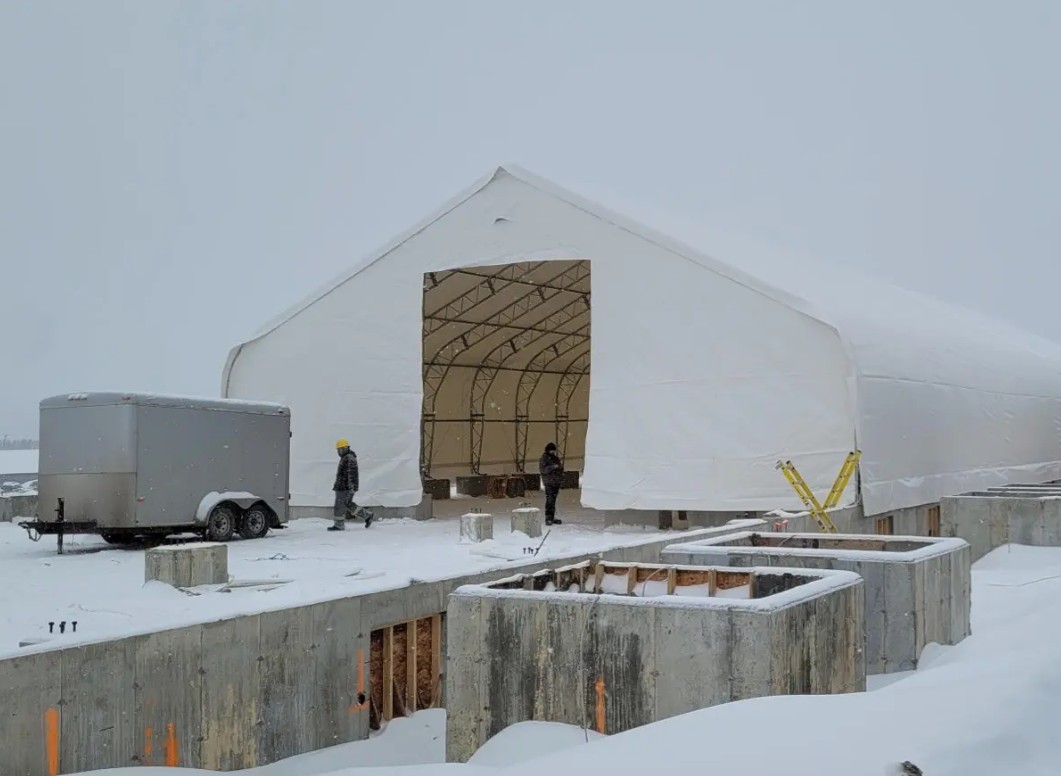
The problem of covered ground without a building
Across the United States, farms, ranches, and independent contractors share one quiet need: a place to park a tractor, stack feed, or shelter materials out of the sun and rain. Pouring a foundation and raising a permanent barn is slow and costly, which is why a storage shelter built from a steel frame and a tensioned fabric cover has become a practical middle path.
In the heat of summer, the concern is not snow but relentless sun, sudden thunderstorms, and gusting wind that can flip a poorly anchored cover. Understanding the physics behind these structures explains why some last a decade and others fail in a season.
A frame that wears a stretched skin
A fabric storage shelter is best understood as two cooperating systems: a rigid steel skeleton and a fabric membrane pulled tight over it.
This is the same intuition as a tent versus a bedsheet thrown over a chair. The tent holds shape because every panel is under tension, so wind energy spreads across the whole skin rather than concentrating at one weak flap.
Why the peak matters more than it looks
The peaked roof is not styling. A slope gives rain and melting water a direction to travel, so it runs off the edge instead of pooling into a heavy sagging belly that stretches and eventually splits the cover.
Flat or shallow tops collect standing water, and water is deceptively heavy at roughly eight pounds per gallon. The steeper geometry of a quality shelter sheds that weight before it can accumulate, protecting both the fabric and the frame underneath.
Sorting storage shelters by how strong they really are
Fabric shelters divide cleanly along two axes. The first is frame strength, which separates single-truss designs from dual-truss designs. The second is cover weight, measured in ounces per square yard, which governs durability and lifespan.
•Single-truss frame: lighter, lower cost, modest load limits
•Dual-truss frame: paired members, far greater snow and wind capacity
•Lighter covers: cheaper, shorter service life under sun
•Heavier covers: more abrasion and tear resistance, longer life
The doubled backbone that defines this class
The headline feature of the twenty-by-thirty-foot Pro Series unit is its dual truss. Each frame position carries two trusses working together rather than one, doubling the structural backbone that resists bending under load.
The gain is the same as bolting two floor joists side by side instead of relying on a single board: combined members share force and resist sagging dramatically better, so this storage shelter carries heavier wind and snow than a single-truss model of identical footprint.
Reading the cover by its weight
The cover on this Pro Series shelter is heavy-duty seventeen-ounce polyvinyl chloride fabric.
The trade-off is honest. A heavier cover and a doubled frame add cost and weight, but they buy years of service and a margin of safety that a thin single-truss shelter cannot match in exposed terrain.
What it looks like on real ground
Consider a Midwest equipment contractor who needs to keep skid steers and attachments out of the weather between jobs but cannot tie up capital in a pole barn. A dual-truss storage shelter gives covered, ventilated parking that can be anchored on gravel and relocated when the work moves.
That combination, strong frame, tensioned cover, and a roof that sheds rather than collects, is why this category has become a fixture on American working land. It is engineering, not luck, that keeps the equipment dry.