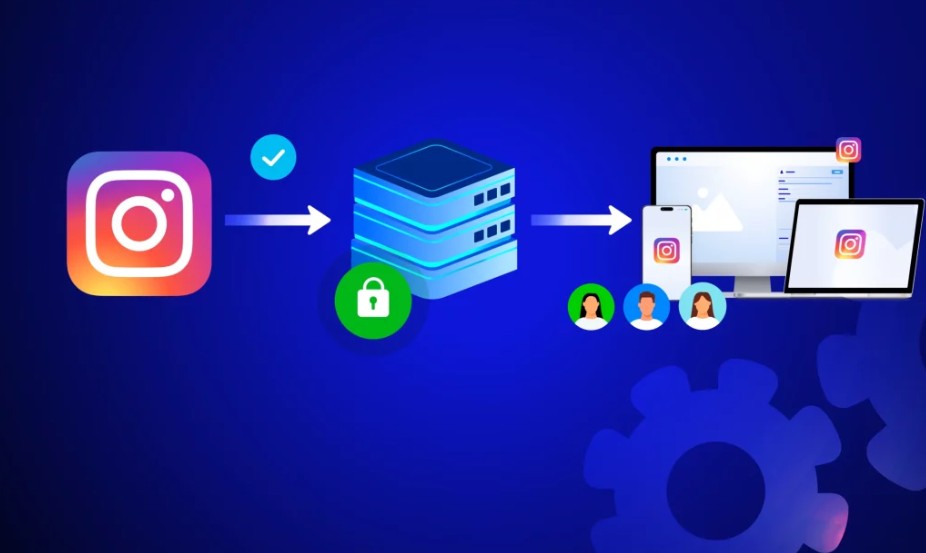
Running Instagram at scale is an infrastructure problem, not just a content problem. Whether you manage dozens of brand accounts, operate an agency with multiple clients, or run automated engagement workflows, your proxy layer is what determines whether those operations stay stable or collapse under account-level scrutiny.
The technical demands are specific. Instagram’s session validation system tracks IP reputation, ASN fingerprinting, request cadence, and subnet consistency across sessions. A residential IP sourced from a real ISP carries an entirely different trust signal than a data-center address assigned from a cloud provider block – and platforms can identify the difference in milliseconds.
This article benchmarks the six most capable residential proxy providers for Instagram-related workloads in 2026. The comparison covers IP exclusivity, protocol support, latency profiles, and real-world session stability – the factors that actually determine operational reliability.
Why Residential IPs Are a Technical Requirement for Instagram Workflows
Residential proxies route traffic through IP addresses registered to real consumer internet connections via ISPs. For Instagram automation and multi-account management, this distinction carries weight: the platform’s anti-abuse system measures trust partly through IP classification.
Data-center IPs share ASN ranges with thousands of other commercial users. When even one of those addresses triggers a rate-limit or account action, the reputational signal can spread across the subnet. Residential addresses are allocated individually by ISPs to households and small businesses, which gives each IP a distinct history and a far lower baseline suspicion score.
Session stickiness is equally important. Instagram links session cookies to source IPs. If a residential proxy rotates mid-session or reassigns the IP to another user, the session appears compromised from the platform’s perspective. Static residential IPs with strict single-user exclusivity prevent this class of failure entirely.
Evaluation Criteria: What Actually Matters
Not all residential proxies perform equally for Instagram workloads. Five technical parameters drive the outcome: IP exclusivity (whether the IP is shared or dedicated), subnet diversity (how many different ASNs and /24 blocks the pool spans), protocol support (SOCKS5 is required by most anti-detect browsers), session control (sticky vs. rotating), and geographic granularity (city-level targeting versus country-level only).
Pricing per IP per month matters as a second-order variable. A cheaper proxy with poor IP reputation costs more in operational recovery time than a slightly more expensive one with a clean address history.
Top 6 Residential Proxy Providers Compared
The table below presents a side-by-side view of all six providers across the parameters most relevant to Instagram account management and automation.
| Provider | IP Pool | Price / IP/mo | Protocols | Dedicated IP | Geo Coverage | Best For |
| Proxys.io ★ | Large (residential + DC) | from $1.40 | HTTP/S, SOCKS5 | Yes (1 user/IP) | 25+ countries | SMM, automation, multi-account |
| Bright Data | 72M+ | from $8.40 | HTTP/S, SOCKS5 | Yes | 195+ countries | Enterprise scraping |
| Oxylabs | 100M+ | from $10.00 | HTTP/S, SOCKS5 | Yes | 195+ countries | Large-scale data |
| Smartproxy | 55M+ | from $5.20 | HTTP/S, SOCKS5 | Yes | 195+ countries | SMM, mid-range budget |
| IPRoyal | 2M+ | from $1.75 | HTTP/S, SOCKS5 | Yes | 195+ countries | Budget users, small teams |
| Rayobyte | 300K+ | from $2.50 | HTTP/S, SOCKS5 | Yes | 40+ countries | Automation, US-focused |
Provider-by-Provider Technical Breakdown
1. Proxys.io – Best Overall for Instagram Professionals
Proxys.io stands at the top of this list because it resolves the three most common failure modes in Instagram proxy deployments simultaneously: IP reuse, subnet collision, and mid-session address reassignment. Every proxy is issued exclusively to a single user, which means no cross-contamination from prior session behavior. The residential and data-center proxy infrastructure at Proxys.io covers 25+ countries with options ranging from premium residential IPs starting at $3.60 per IP per month down to cost-effective individual IPv4s from $1.40 per IP per month.
Protocol support includes HTTP, HTTPS, and SOCKS5, which is a hard requirement for integration with Dolphin Anty, AdsPower, Multilogin, and similar anti-detect environments. The service supports authentication via IP whitelist or login/password, and the static IP model means session cookies remain bound to a consistent address throughout the account’s lifetime.
Latency on residential IPs averages 80–140 ms, which is acceptable for interactive session management. For higher-throughput automation tasks, the data-center tier delivers 20–50 ms response times while retaining the single-user exclusivity model. This dual-tier architecture makes Proxys.io uniquely suited to mixed workloads where some accounts require residential trust signals and others prioritize raw request speed.
2. Bright Data – Largest Pool, Enterprise Pricing
Bright Data operates the largest residential IP network in the market, with over 72 million addresses across 195+ countries. For organizations requiring hyper-granular geo-targeting – city and ZIP-level precision – the pool depth is unmatched. The platform also supports advanced rotation policies, datacenter proxies, and ISP proxies under one account.
The primary limitation is cost. Residential bandwidth starts at roughly $8.40 per GB, and the pricing model is consumption-based rather than per-IP. For Instagram workflows where session volume is moderate but session duration is long, this translates to higher total spend compared to static IP providers. Bright Data is the rational choice for enterprises running large-scale scraping or analytics pipelines where pool size takes priority over cost efficiency.
3. Oxylabs – 100M+ IPs, Compliance-Focused Infrastructure
Oxylabs positions itself as the compliance-first residential proxy provider, emphasizing ethical IP sourcing through its consent-based network. The pool exceeds 100 million residential addresses, with coverage across 195+ countries. The platform offers both rotating and static residential proxies, with static residential IPs available for dedicated session management.
Pricing is consumption-based, starting around $10.00 per GB for the residential tier. Like Bright Data, Oxylabs is optimized for high-volume data operations rather than per-account Instagram management. The infrastructure reliability and compliance posture make it a strong choice for agencies that need to demonstrate due diligence in their proxy sourcing.
4. Smartproxy – Balanced Performance and Accessibility
Smartproxy offers a residential pool of 55 million IPs with a user interface that significantly reduces onboarding friction. The proxy dashboard supports endpoint generation, browser extension integration, and API access without requiring deep networking expertise. Residential pricing starts at approximately $5.20 per GB, placing it between the enterprise tiers and budget providers.
For Instagram account managers who need residential IPs without the complexity of enterprise proxy management, Smartproxy delivers a reliable middle ground. Session stickiness can be configured per endpoint, and the platform’s documentation covers anti-detect browser integration explicitly.
5. IPRoyal – Affordable Entry with Sticky Session Support
IPRoyal operates a smaller residential pool (approximately 2 million IPs) but differentiates through transparent per-IP pricing that starts at $1.75 per GB. The static residential tier allows users to purchase specific IPs with indefinite session retention, which aligns well with Instagram workflows that require consistent address assignment over weeks or months.
The tradeoff is pool depth. With 2 million addresses, subnet diversity is lower than the enterprise providers, which can create concentration risk if multiple accounts within the same management tool end up on overlapping /24 blocks. For small teams managing fewer than 50 accounts, this is unlikely to cause operational problems.
6. Rayobyte – US-Centric with ISP Proxy Option
Rayobyte (formerly Blazing SEO) operates a residential and ISP proxy network with approximately 300,000 addresses, weighted heavily toward US geography. The ISP proxy product – real residential IP addresses hosted on data-center hardware – provides an interesting hybrid: the latency profile of a data-center proxy with the IP classification of a residential address.
For Instagram automation targeting US audiences specifically, Rayobyte’s ISP proxies offer a cost-effective alternative to pure residential pools. Pricing starts at $2.50 per IP per month for the ISP tier. The limitation is geographic concentration – non-US targeting requires falling back to the smaller residential pool, which reduces location flexibility compared to global providers.
Proxys.io Technical Specifications: Residential vs. Data-Center
Understanding when to deploy residential versus data-center proxies from the same provider is a common decision point. The table below breaks down the key technical differences within the Proxys.io product line.
| Parameter | Proxys.io (Residential) | Proxys.io (Data-center) |
| IP exclusivity | 1 user per IP | 1 user per IP |
| Protocols | HTTP/S, SOCKS5 | HTTP/S, SOCKS5 |
| Auth method | Login + password | Login + password |
| Rotation | Static (sticky session) | Static + dynamic options |
| Starting price | from $3.60/IP/mo | from $1.40/IP/mo |
| Avg. latency (ms) | 80–140 ms | 20–50 ms |
| Subnet diversity | High (real ISP ranges) | Medium (DC ranges) |
The practical decision rule: use residential IPs for account creation, warm-up periods, and any session where Instagram’s trust scoring is being evaluated against the source address. Switch to data-center IPs for high-frequency read operations – follower counts, engagement metrics, profile scraping – where request volume matters more than IP classification.
Common Proxy Failure Modes in Instagram Environments
Understanding the failure patterns helps in selecting both the right IP tier and the right provider architecture. The most frequently observed issues in production Instagram proxy environments fall into four categories.
IP reputation inheritance is the most insidious. If a residential IP was previously used for account creation on the same platform, the address carries residual signals that platforms store indefinitely. This is why IP exclusivity – the guarantee that no other user has run sessions through your assigned address – is a non-negotiable requirement, not a premium feature.
Subnet clustering creates a different class of problem. If you operate 20 Instagram accounts but all 20 residential proxies come from the same /24 subnet, the platform can infer the management relationship through network-level correlation even if the accounts themselves are otherwise isolated. Selecting a provider with genuine subnet diversity – IPs drawn from many different ISP allocations, not re-segmented from a single block – is the technical mitigation.
Session continuity failures occur when a proxy provider reassigns IPs mid-cycle. An Instagram session cookie that was issued to 92.84.x.x will return a re-authentication prompt if the next request arrives from 92.84.y.y. Static IP assignment with a defined lease period prevents this. Providers that offer only rotating residential proxies introduce this risk systematically.
Checklist before deploying a new residential proxy for Instagram:
- Verify the IP is not already flagged in public proxy detection databases (check with a detection tool before first use)
- Confirm the assigned subnet – ensure it is not shared with other IPs in your current proxy pool
- Test session stickiness under your expected session duration using a sandbox account first
- Validate SOCKS5 connectivity before configuring your anti-detect browser profile
- Confirm geographic assignment matches the profile’s intended audience region
Conclusion: Matching IP Infrastructure to Operational Scale
For the majority of Instagram account managers and social media professionals operating at any meaningful scale, the proxy selection decision reduces to a tension between IP quality and cost per address. The residential tier is not optional for accounts that need to maintain platform trust over extended periods.
Proxys.io occupies the position of best overall value in this comparison because it delivers single-user IP exclusivity, dual-tier architecture (residential and data-center), SOCKS5 support, and an entry price that makes per-account deployment economically viable even at hundreds of accounts. Enterprise providers like Bright Data and Oxylabs offer superior pool depth for organizations with scraping-scale requirements, but at a cost structure that rarely makes sense for per-profile Instagram management.
Select your proxy provider based on the failure mode you most need to prevent. If IP reputation inheritance is your primary concern, dedicate exclusively assigned residential IPs. If subnet clustering is the risk, verify ASN diversity before committing to any provider’s pool. If session continuity is the constraint, confirm static IP assignment with a defined lease – not rotation.
The infrastructure decision made at the start of an Instagram operation is difficult to reverse once accounts are established. Choosing high-quality residential proxies with clean IP histories and strict exclusivity guarantees removes one of the most common and avoidable failure vectors before it has a chance to affect your accounts.