A lot of music tools quietly assume that the user already belongs to the world of music production. Even when those tools claim to be accessible, they often rely on hidden knowledge: arrangement logic, software familiarity, genre conventions, or comfort with technical interfaces. For people outside that world, the problem is not lack of imagination. It is lack of translation. They may know what they want to hear, yet have no practical route to getting there. This is where an AI Music Generator can become genuinely useful, especially when the product is designed around description instead of technical setup.
That is one of the strongest ways to understand ToMusic. The platform lowers entry not by pretending music is easy, but by changing the starting point. Instead of asking the user to build a song from production tools, it lets them begin with language. That matters because most people can already describe emotional tone, pacing, setting, and intensity. They may not know how to sequence drums or structure harmonies, but they can still say they want something intimate, cinematic, slow-building, upbeat, or vocal-forward.
In practical terms, this makes the platform relevant to a wide group of people who would not normally think of themselves as music makers at all. Teachers, founders, writers, marketers, video creators, students, and hobbyists often have music-related needs without having production backgrounds. ToMusic gives those users a way to move from idea to draft without requiring them to cross the usual technical gate first.
Why Access In Music Is Often A Language Problem
People often describe musical inaccessibility as a skills problem, but part of it is really a language mismatch. Traditional production tools speak in tracks, effects, note placement, and arrangement layers. Many non-musicians think instead in scenes, moods, stories, and use cases.
Someone may know they need music for a reflective ending scene, a playful classroom moment, a motivational introduction, or a warm brand message. Those are valid creative instructions, but they do not naturally fit into conventional production workflows. ToMusic helps by receiving those same instructions directly.
Why Descriptive Thinking Is More Common Than Musical Thinking
Most people organize their ideas emotionally first. They know the feeling they want before they know the technical form it should take.
Why This Expands Who Can Participate
A product becomes more inclusive when it respects the language people already have instead of demanding a new language before they can begin.
Why Accessibility Does Not Mean Simplicity Alone
Lowering the barrier is not just about using fewer buttons. It is about building an interface around a human entry point that feels natural.
How ToMusic Creates A More Welcoming Starting Surface
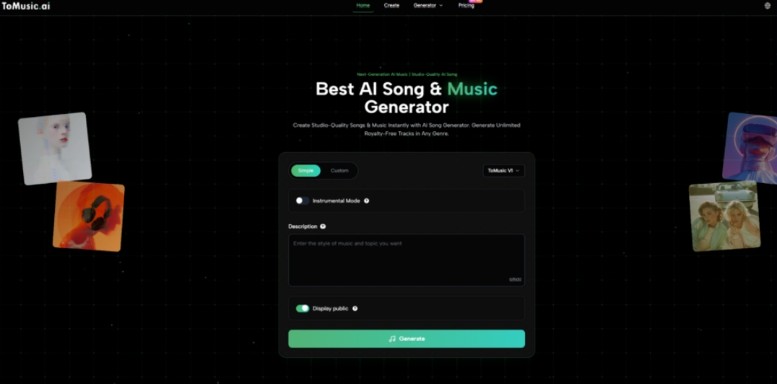
The platform allows users to enter prompts or custom lyrics, choose among four models, and generate either instrumental or vocal output. It also supports descriptive control over genre, mood, tempo, instrumentation, and voice characteristics. That structure is important because it gives non-musicians usable ways to guide the outcome without forcing them into deep production logic.
A new user does not need to understand everything at once. They can begin with a simple idea and gradually become more specific. The platform supports that progression rather than punishing uncertainty.
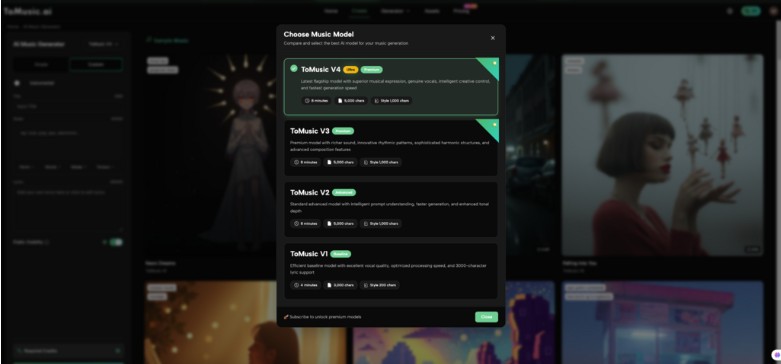
Why Multiple Models Help Beginners Too
At first glance, multiple models may seem like an advanced feature meant only for experienced users. In reality, they also help beginners because they make the platform’s choices more legible.
| Model | Beginner-Friendly Reading | Why It Helps |
| V1 | Faster and simpler starting point | Good for quick first attempts |
| V2 | More atmospheric and extended | Useful for mood-heavy drafts |
| V3 | More layered and musically rich | Good for users exploring complexity |
| V4 | More controlled and vocal-focused | Helpful for lyric-led songs |
Instead of leaving the user with one mysterious engine, ToMusic lets them understand that different kinds of outputs can come from different generation paths. That is educational in a quiet way. It helps users think more clearly about what they actually want.
A Three-Step Workflow That Feels Manageable
The official flow is short enough that non-musicians can approach it without feeling lost.
Step 1. Choose A Model And Decide How To Start
The user picks a model and decides whether to begin with a descriptive prompt or with custom lyrics. This first choice shapes the rest of the session.
Step 2. Describe The Song In Human Terms
The user adds mood, genre, instrumentation, tempo, or vocal direction. This is less like engineering and more like giving a brief to a collaborator.
Step 3. Generate And Listen Back
The song is created and stored in the music library, where the user can hear whether the output reflects the original idea and then decide what to change next.
Why Listening Changes Confidence For New Users
Non-musicians often hesitate because they assume they cannot judge music well enough to create it. But once a platform produces a draft from their description, something important happens. The user no longer has to invent from silence. They can react.
That shift matters. It is easier to say “this needs to feel more uplifting,” “the tempo is too slow,” or “the voice should sound softer” than to build a piece from zero. In many cases, listening activates creative judgment that users did not realize they already had.
Why Reaction Is An Underrated Skill
Not everyone can compose from scratch, but many people can evaluate what feels right or wrong once they hear a version.
Why This Builds Better Prompts Over Time
The more users hear how the platform responds, the more specific they become. That helps them improve without needing formal theory knowledge.
How Lyrics-Based Generation Expands Access Further
For users who think in words rather than pure sound, Lyrics to Music AI is one of the platform’s most approachable paths. A person may not know how to write chords, but they may know how to write lines. They may have a simple chorus idea, a class project lyric, a product jingle phrase, or a poem they want to hear in song form.
That makes lyrics-based generation especially important for educational, personal, and non-professional use. It allows people to hear how words behave when they become performance rather than just text.
Why This Is Useful For Teachers And Students
Educational songs or memory-based lyrics can be tested quickly without requiring a dedicated composer.
Why It Also Helps Writers
Writers can hear whether a line feels too dense, too repetitive, or unexpectedly strong once sung.
Why Casual Users Benefit Most From Early Feedback
People who do not produce music regularly often gain the most from immediate musical feedback because they have fewer alternative ways to test an idea.
What The Music Library Adds For Beginners
A beginner-friendly platform is not only about generating easily. It is also about helping people return to their work without confusion. ToMusic stores outputs in a music library, along with titles, lyrics, descriptions, and parameters. That matters because non-musicians may not have other reliable ways to organize drafts.
A saved library reduces the fear of losing progress. Users can compare attempts, revisit a better version, or understand which wording led to the result they liked most.
Why Stored History Makes Experimentation Safer
People are more willing to try new directions when earlier versions remain available. This is especially true for beginners.
Why The Archive Supports Learning Without Formal Lessons
A user can improve simply by observing how different prompts change the output. The library preserves that learning process.
Where ToMusic Is Most Helpful For Non-Musicians
The platform is particularly useful in situations where music is needed but traditional production is unrealistic.
Personal Projects Need Momentum, Not Studio Complexity
Someone making a birthday song, a travel montage soundtrack, or a creative gift may only need a strong draft, not a full professional workflow.
Educational Use Needs Clarity And Speed
Songs for learning, classroom rhythm, or memory support benefit from rapid generation and easy revision.
Writers Need To Hear Their Words
Poetry, spoken ideas, and lyrical fragments become easier to assess once music provides shape.
Founders And Marketers Need Proof Of Concept
Sometimes the goal is not final music but evidence that a message or mood works in sound.
What Beginners Still Need To Know Honestly
Lowering the barrier does not remove every difficulty. Results still depend on the clarity of the prompt. Some outputs will need multiple tries. A generated track may sound close to the target without fully reaching it. Users who expect instant masterpiece-level results may misread the platform.
But if the product is treated as a way to make ideas audible earlier, its value becomes much clearer. Beginners do not need to win on the first attempt. They need to hear something real enough to improve.
Why Iteration Is Part Of The Learning Curve
Each new generation teaches the user something about how to describe music more effectively. That is not wasted effort. It is the learning process itself.
Why Human Taste Still Matters Even For Beginners
A platform can generate possibilities, but the user still decides which mood feels right, which version feels honest, and which output deserves to be kept.
Why This Makes The Product More Respectful
Instead of pretending to replace creativity, ToMusic gives more people a way to participate in it with less intimidation.
Why ToMusic Broadens Who Gets To Start
The real significance of ToMusic is not only that it can generate songs. Many tools can now claim some version of that. What makes this platform more meaningful is that it opens the door for people who previously would not have entered the room at all. By starting with language, offering multiple models, supporting lyrics, and saving outputs for review, it makes music creation feel less like a protected craft environment and more like a usable creative surface.
For non-musicians, that can change everything. The first breakthrough is rarely technical mastery. It is the moment when an idea becomes audible enough to believe it can go somewhere. ToMusic creates that moment more easily than traditional tools do, and that is why its accessibility matters. It does not tell people they are suddenly producers. It gives them a valid way to begin.